Responsible consumption and production: fewer paper scorecards on the mini golf course.
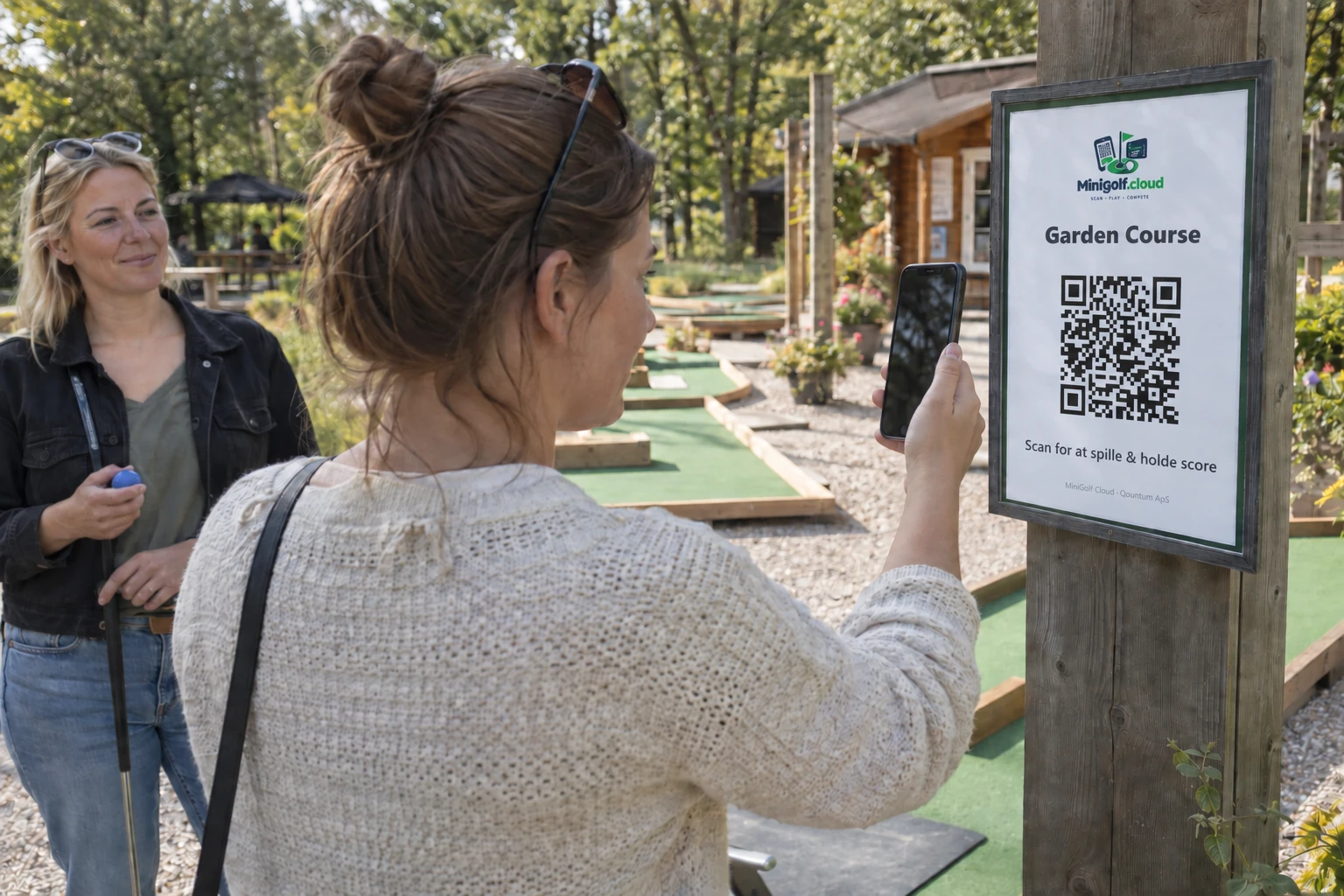
When guests use their own phones, the course no longer has to print, hand out and throw away thousands of scorecards every season. One QR sign per course replaces the paper cards.
PER COURSE, PER SEASON
What does a typical mini golf course save?
Example: 150 opening days from May to September, an average of 100 guests a day and groups of about 3 people sharing one scorecard.
scorecards per season
~5,000About 33 scorecards a day for 150 days
~25 kgPaper saved
~2,500 LProcess water at the paper mill
~25 kgCO2e from paper production
~50 kgWood for new paper
SEASONAL OR YEAR-ROUND
The savings follow the opening days.
Outdoor courses in the Nordics are typically open seasonally. Indoor courses and courses in warmer climates can stay open all year, which more than doubles paper consumption.
Smaller local course
About 150 opening days and around 50 guests a day
Scorecards
~2,000
Paper
~10 kg
Water
~1,000 L
CO2e
~10 kg
Typical outdoor course in the Nordics
May to September, about 150 opening days and 100 guests a day
Scorecards
~5,000
Paper
~25 kg
Water
~2,500 L
CO2e
~25 kg
Year-round course
Indoor or in a warmer climate, about 350 opening days and 100 guests a day
Scorecards
~11,500
Paper
~58 kg
Water
~5,800 L
CO2e
~58 kg
BEYOND THE NUMBERS
Less paper on the course.
No scorecards blowing away or getting lost on the course.
No shipping of scorecard pads from the printer and no used cards going to waste.
No reordering of cards and pencils in the middle of the season.
TRANSPARENCY
Sources and assumptions
The figures are estimates. Actual savings depend on the number of guests, group size, opening days and paper type.
Scorecards: about 5 grams per card on 160–200 g/m² paper. A group of about 3 guests shares one card.
Water: up to about 100 liters of process water per kg of new paper. Recycled paper typically uses 10–15 liters per kg. European paper mills range from 10–300 m³ per ton.
Including the water used for forest growth, the total water footprint is 300–2,600 liters per kg of writing and printing paper (Water Footprint Network).
CO2e: about 1 kg CO2e per kg of paper. Estimates range from about 0.7 kg for recycled paper to about 1.5 kg for new paper.
Wood: about 2 kg of wood per kg of new paper. Recycled paper is made from existing fibers.
Not included: printing, delivery and disposal of cards, or power for phones, networks and servers.
Read more about Goal 12 from the UN: un.org/sustainabledevelopment
Scan at the course
One QR sign works again and again.
A digital scorecard replaces the paper card the group would otherwise carry around. Print the QR sign for the course and let guests record strokes on their own phone.